Events | 05-07-26
Live Discussion on Prediction Markets: Enforcement Signals & Emerging Risks
Prediction markets can no longer be considered a fringe issue, something recent enforcement activity is making clear.
Kalshi, a regulated prediction market platform, recently took action against individuals who traded on outcomes where they had direct, non-public insight. The message that sends is straightforward: even small trades can trigger enforcement when market integrity is at risk.
A few key takeaways from these cases stand out:
- Context matters, and cooperation impacts outcome. Traders who acknowledged violations received settlements, while a trader who did not cooperate faced a harsher disciplinary action.
- Rules are enforceable and enforced. These cases were handled under Kalshi’s CFTC-approved exchange rules, with the potential for referral to regulators (e.g., CFTC or DOJ) in more serious situations.
- Behavior matters more than size. Even small trades were penalized where participants could influence outcomes, reinforcing a strict approach to market integrity.
For compliance teams, this should immediately raise questions like: Are our employee trading policies keeping pace with event-based contracts? Does our surveillance program capture activity on emerging platforms? How should our firm think about MNPI in non-traditional contexts?
Join the Conversation Live on May 7
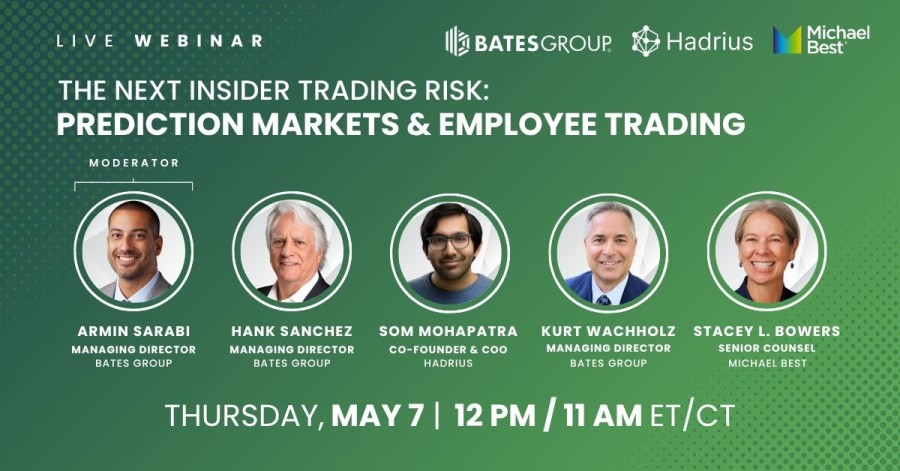
To help firms navigate this emerging risk area, Bates Group and Hadrius are hosting a live discussion Thursday, May 7, 2026 at 12 p.m. ET, featuring legal, compliance, and regulatory experts from Bates Group, Hadrius, and Michael Best.
Key Insights:
- What prediction markets are and why they matter now — how event-based contracts work, how they're being classified, and why adoption is accelerating
- Why regulators are focused on this space — the insider trading, MNPI, and manipulation risks drawing scrutiny from the CFTC, SEC, and state regulators
- Where firms are most exposed — the supervision and surveillance gaps that leave employee trading activity unmonitored across accounts, products, and workflows
- What a compliant framework looks like in practice — from policy design and pre-clearance requirements to event-driven surveillance, restricted lists, and scalable enforcement
- How to move from policy to systems — why compliance infrastructure, not documentation alone, is what firms need to enforce controls consistently at scale